Septimus Warren Smith’s death
Mrs DallowaySeptimus Warren Smith’s death is the novel’s decisive collision between a suffering man’s need for privacy and self-determination and the authority of those who claim to treat him. After Dr. Holmes presses into the house despite Lucrezia’s refusal, Septimus jumps from a window rather than submit to the doctors’ intervention. The death is not presented as a simple resolution: it leaves Lucrezia bereaved, reaches Clarissa Dalloway at her party, and becomes for Clarissa a terrible act of defiance and communication.
Background and Escalation
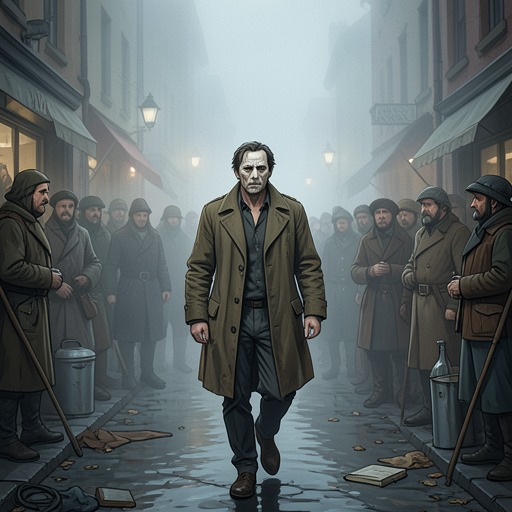
Septimus’s crisis is shaped by experiences he cannot reconcile with the ordinary expectations imposed on him. In a London street, aged about thirty, pale-faced and apprehensive, he becomes caught in the stillness around a stopped motor car. The gathered traffic and the attention of onlookers make him feel exposed and fixed in place, as though he were being watched for an unknown purpose. The episode establishes how public surroundings can become threatening through his perception, rather than offering him the safety of a private interior.
In Regent’s Park, the sight of smoke-writing in the sky produces the opposite but equally overwhelming response. Septimus reads the shapes as signs addressed to him, and beauty seems to arrive as an inexhaustible gift. The nursemaid explains that the smoke advertises toffee; the ordinary explanation does not erase the intensity of Septimus’s experience. This contrast between his sense of revelation and other people’s matter-of-fact interpretations recurs in the events leading to his death: his perceptions are consequential to him, while the people charged with helping him fail to meet them on their own terms.
His estrangement also enters his marriage. When Lucrezia removes her wedding ring and explains that her hand has grown thin, Septimus takes the gesture to mean that their marriage has ended and that she has left him. He imagines himself alone, charged with delivering truths to the Prime Minister and the Cabinet: that trees are alive, that there is no crime, and that love is universal. The gulf between Lucrezia’s explanation and his interpretation shows how their shared life has become vulnerable to misunderstanding, even when she is beside him.
The pressure on Septimus is inseparable from his memories of war. He judges himself for not having cared when Evans was killed, treating that failure of feeling as the worst of his offenses. Lucrezia, meanwhile, sees a husband who can abruptly become excited, fall silent, laugh, or ask her to write down his thoughts. A drawer fills with writings about war, Shakespeare, discoveries, and the idea that there is no death; she records his words, but the written pages do not resolve the distance between his experience and hers.
The Attempt to Control His Treatment
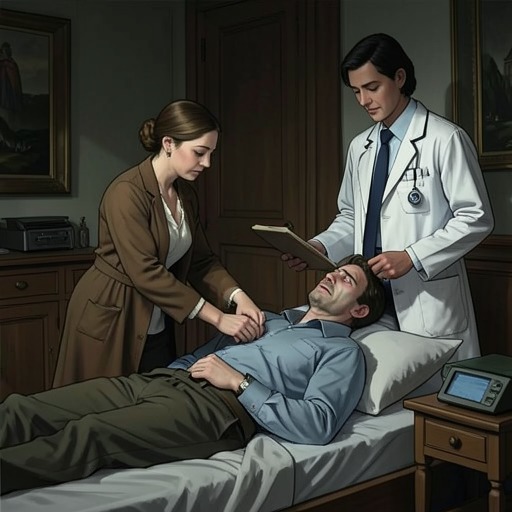
Sir William Bradshaw frames Septimus’s condition as a matter of rest and proportion. He tells Lucrezia that Septimus has threatened to kill himself and that there is no alternative to a stay in a country house, where nurses will care for him and Bradshaw will visit weekly. The plan depends on separating husband and wife: Bradshaw says that the people one cares for most may not be good for them during illness. Lucrezia asks whether Septimus is mad, but Bradshaw avoids that term, describing the issue instead as a lack of a sense of proportion.
The decision is presented to Lucrezia as a question of law, not an arrangement she can meaningfully negotiate. After Bradshaw’s conversation with her, Septimus sits under a skylight, looking at a photograph of Lady Bradshaw in court dress and muttering about beauty. The scene places him under the authority of a medical system that proposes removal and isolation while giving little weight to the world as he experiences it.
At home, Lucrezia tries to protect him when she hears someone downstairs and fears that Dr. Holmes has come. She runs down to prevent Holmes from reaching her husband, and tells him she will not allow him to see Septimus. Holmes puts her aside and continues upstairs. Her resistance makes the threshold of the house a direct point of conflict: she seeks to keep the doctor out, while Holmes treats access to Septimus as his right.
The Window and Its Consequences
From inside the room, Septimus hears Holmes approaching and imagines what will happen if the doctor reaches him. He considers other means of escape, including Mrs. Filmer’s bread knife, but sets it aside; the razors have been packed. With Holmes coming, he turns to the open window of the Bloomsbury lodging house. Septimus does not describe himself as wanting to die: he thinks that life is good and intends to wait until the last moment. When Holmes reaches the door, Septimus cries out and jumps from the window onto Mrs. Filmer’s area railings.
The action immediately changes the lives of those in the house. Holmes enters and calls Septimus a coward. Lucrezia runs to the window and understands what has happened; Holmes and Mrs. Filmer collide as people rush through the house. Holmes returns with a drink for Lucrezia and tells her that her husband will not recover consciousness, that she must not see him, and that an inquest remains ahead. He calls the death a sudden impulse and says no one is to blame, while admitting he cannot understand why Septimus did it. His explanation cannot account for the conflict the preceding events have shown: Septimus had feared Holmes’s arrival, and Lucrezia had tried to prevent it.
The death thus ends the immediate attempt to bring Septimus under medical control, but it does not settle the meaning of his act. Lucrezia is left to absorb the news and its aftermath, while the account offered by Holmes reduces the event to an unforeseeable impulse. The gap between that explanation and Septimus’s conscious effort to avoid the approaching doctor keeps the death from being treated as an uncomplicated medical case.
News at Clarissa Dalloway’s Party
At Clarissa Dalloway’s party, Lady Bradshaw explains that her husband was called to a very sad case: a young man who had been in the army had killed himself. Clarissa receives the news in the midst of her gathering and thinks of death suddenly entering her party. She withdraws into a small room, where the chairs still bear the impression of the Prime Minister and Lady Bruton, but no one is there. The contrast between the crowded party and Clarissa’s solitary moment makes the news interrupt the social occasion without making the death part of the party’s public conversation.
Clarissa is disturbed that the Bradshaws speak of a death at her party. She imagines the young man’s fall and asks herself why he did it; her response is bodily and immediate, although the young man is a stranger to her. She compares his act with the small act of throwing a shilling into the Serpentine, but recognizes the difference: he had thrown his life away. Around her are the continuing demands of the party, and she knows she must return to the rooms where people are still arriving.
The news also draws together the day’s earlier thoughts of Bourton, Peter Walsh, and Sally Seton. Clarissa sees that people will grow old, while something essential can be obscured in ordinary life by talk, lies, and daily corruption. She interprets Septimus’s death as defiance and as an attempt to communicate: people cannot reach one another’s centres, closeness can give way to distance, and rapture can fade into solitude. That reading does not undo the loss or make Clarissa an intimate witness to Septimus’s life. Instead, the death briefly crosses the boundary between two lives that have not met, giving Clarissa a way to recognize the isolation that her own social world cannot dispel.